

Nov 22, 2021
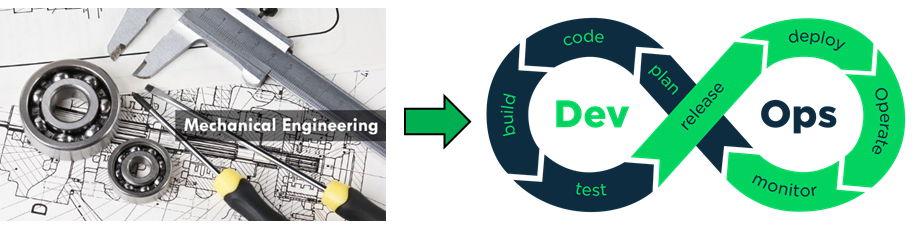
My name is Abdurahman Abukar. A recent Mechanical Engineering graduate. Not long ago, I made the switch to DevOps engineering, and because of the increasing popularity of the world of technology, many were curious about how and why I did it. I receive questions like, how did you go from Mechanical to DevOps? What is DevOps? What is Cloud? How did you break into tech? What led you to make the switch? Given that I have answered these questions plenty of times, I thought why not compile them into an article.
Firstly, the thought of having to make a complete switch from your degree subject can feel daunting but I would like to argue that this is far from the truth. Initially, I thought the same; a degree I spent three years doing all ended up down the drain. But the truth is, although I loved studying Mechanical engineering, particularly due to the abundance of problem-solving it had, I began researching job opportunities. While it seemed there were plenty, the career progression was not as attractive as I imagined. The figure above shows that a senior engineer, who has been in the field for almost 5 years, will be on a salary of a measly £42,000 as opposed to a DevOps engineer of the same caliber being on a salary upwards of £75,000.
Driven by the idea of a lack of an appealing career progression and job prospect, combined with the recurring question, ‘Do I really want to be a Mechanical Engineer my whole life?’, I decided to make the switch, but wasn’t entirely sure if I would enjoy DevOps. This was all during my third year of university, and because of the lockdown, there was a rising demand for DevOps engineers as there were more companies making the move to the Cloud and realizing the importance of DevOps in their organization. This brings us to our first question.
DevOps is the term given to a set of best practices and the combination of various technologies that ensures an organization can deliver its application as fast as possible. The reason the idea of DevOps was appealing to me was because of the vast number of technologies I would thus be exposed to and had to learn, whilst juggling between integrating, testing, building, deploying, and coding.
The use of learning and implementing already existing and fairly new tools meant that I would be exposed to something new every day, and always problem solve. Which in my case was the aspect of my Mechanical Engineering degree that I enjoyed most. So, coupled with this, the impressive career progression opportunities as well as the high demand and salaries, it was really a no-brainer. Moreover, the practical application of DevOps is still increasing, which would in turn result in more and more opportunities.
Cloud has become a buzzword as of late, and in simple terms can be defined as an application-based software infrastructure that stores data on remote servers, which a person or organization does not have to deal with and can be accessed through the internet. So, the reason it is called Cloud is that this data can be accessed on a virtual space pretty much anywhere in the world. Moreover, you have access to Cloud computing services, which is the delivery of computing services such as servers, storage, databases, networking, software, analytics, AI. So, you might wonder, who provides these Cloud computing services? The answer is cloud providers.
A cloud provider is a company that delivers cloud computing-based services to a business. For example, Netflix uses Amazon Web Services (AWS) as their cloud provider to ensure Netflix updates run in the background while you enjoy watching your favorite series. There are many cloud providers, but the three main ones are AWS, Microsoft Azure, and Google Cloud Platform.
Cloud and DevOps go hand in hand, and Cloud has become so intermingled with DevOps that it plays a significant role in application delivery. While DevOps sets out to improve processes and process development, Cloud plays its role by providing collaborative workflow tools to ensure the delivery of applications is as smooth as possible. So, Developers in a DevOps environment can easily provision infrastructure using their code, which speeds up their efficiency. They use various cloud tools to automate the process of building and managing infrastructure. This efficiency is a key term when it comes to DevOps and its definition.
Once I came to understand that tech was not only a lucrative and rewarding career pathway but also a no-brainer choice in terms of offering the opportunity to learn new technologies and apply them on a day-to-day basis, I was certain that it was the route for me. So coupled with my little understanding of Cloud and knowing that Amazon Web Services held the largest market share out of all Cloud providers, and the advice given by a senior DevOps engineer, I took on the Certified Cloud Practitioner Course on Udemy by Stephane Maarek.
Getting certified paved the way for me to continue my learning process and learn more about DevOps processes and important technologies, and not long after, I was offered a role as a Platform Engineer at Capgemini. The development continues as I learn key elements of DevOps and technologies such as Scripting, Docker, Kubernetes, Terraform, Ansible, and more.
The quote that motivated me to keep going until I got into a job role was,
“DevOps is not a Goal, but a never-ending process of continual improvement” — Jez Humble
Coming across the author, Jez, I read his book titled ‘The DevOps handbook, and it really encouraged me and reaffirmed the career pathway I chose for myself — I would strongly recommend anyone who is even slightly interested in DevOps, to read the book. Let me just add ‘Continuous Delivery’ to that list as well.
To end with, building up my DevOps portfolio meant that I had to set aside some time to study for Cloud exams, take on projects, learn the key technologies while spending time doing labs. My final advice for anyone aiming to secure their first role in DevOps is to follow that same route; take out time during the day to learn the important technologies and most importantly, do it because you enjoy it.
What’s next for me?
Currently, I am preparing for Certified Kubernetes Administrator Exam. It is a hands-on exam, which means I am constantly practicing on the terminal, doing lab-based exercises and online Kubernetes environments and terminal, as I go through Mumshad’s course on Udemy.
9
9
DevOps Engineer @ Capgemini 💻 | Co-founder of Deengineers Tech Community | CKA CKAD CKS | 2x AWS Certified
Love podcasts or audiobooks? Learn on the go with our new app.
DevOps Engineer @ Capgemini 💻 | Co-founder of Deengineers Tech Community | CKA CKAD CKS | 2x AWS Certified
Help
Status
Writers
Blog
Careers
Privacy
Terms
About
Knowable