

Get local news delivered to your inbox!
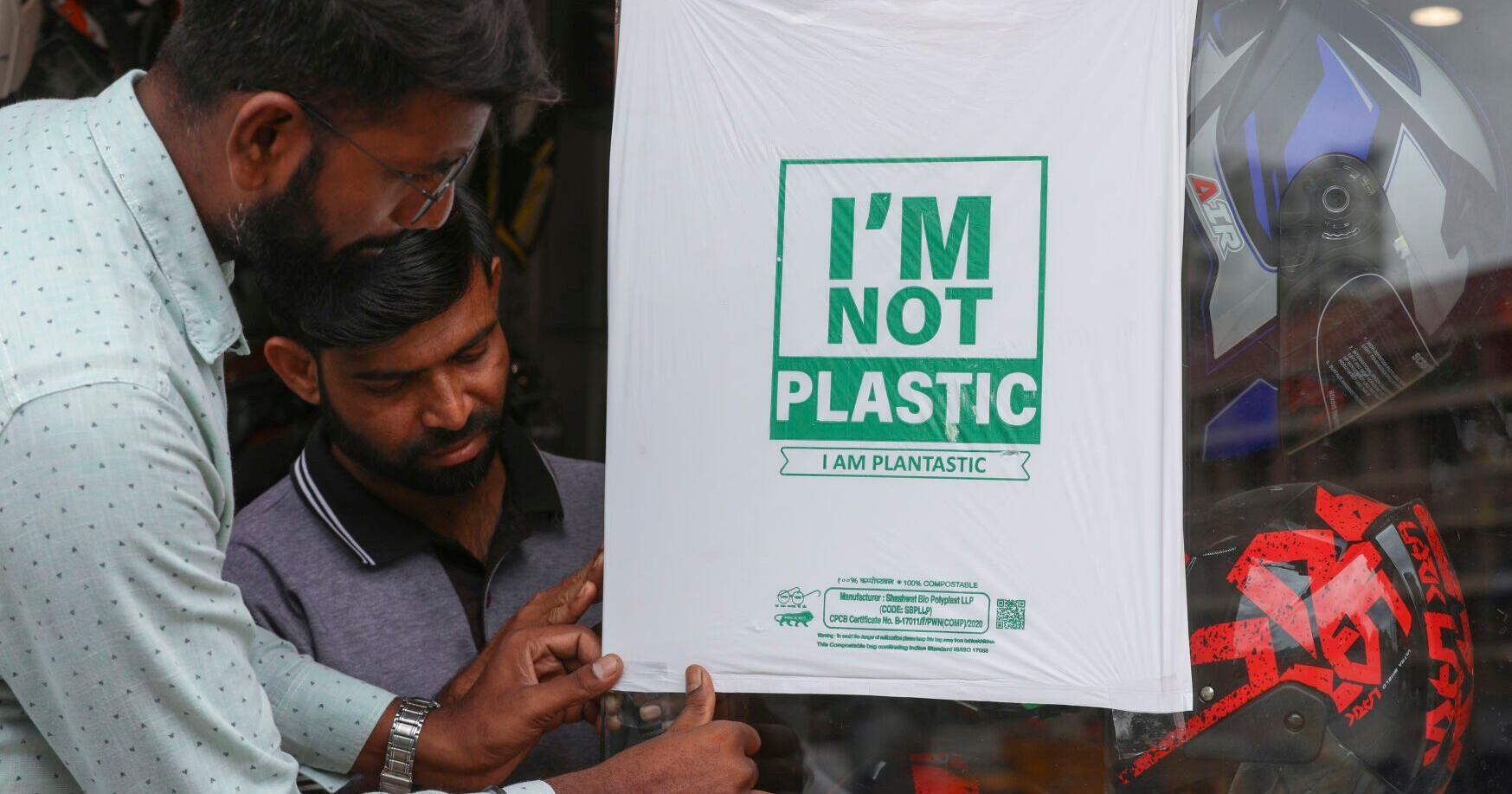
Workers of a helmet store paste degradable plastic substitute material on a glass in Hyderabad, India, Thursday, June 30, 2022. India banned some single-use or disposable plastic products Friday as a part of a longer federal plan to phase out the ubiquitous material in the nation of nearly 1.4 billion people.
A roadside cotton candy vendor drinks water from a plastic pouch as he waits for customers at a weekly market in New Delhi, India, Wednesday, June 29, 2022. India banned some single-use or disposable plastic products Friday as a part of a longer federal plan to phase out the ubiquitous material in the nation of nearly 1.4 billion people.
A roadside vendor packs onions in plastic bags as women shop at a weekly market in New Delhi, India, Wednesday, June 29, 2022. India banned some single-use or disposable plastic products Friday as a part of a longer federal plan to phase out the ubiquitous material in the nation of nearly 1.4 billion people.
A man carrying his tiffin box in a single use plastic cover walks through a street in Hyderabad, India, Thursday, June 30, 2022. India banned some single-use or disposable plastic products Friday as a part of a longer federal plan to phase out the ubiquitous material in the nation of nearly 1.4 billion people.
Cotton candies wrapped in plastic cover are displayed to woo customers at a weekly market in New Delhi, India, Wednesday, June 29, 2022. India banned some single-use or disposable plastic products Friday as a part of a longer federal plan to phase out the ubiquitous material in the nation of nearly 1.4 billion people.
A girl hold a plastic glass as she prepares to drink Shaved ice at Juhu beach in Mumbai, India, Thursday, June 30, 2022. India banned some single-use or disposable plastic products Friday as a part of a longer federal plan to phase out the ubiquitous material in the nation of nearly 1.4 billion people.
A commercial truck transports rolls of plastic used in packing in New Delhi, India, Thursday, June 30, 2022. India banned some single-use or disposable plastic products Friday as part of a federal plan to phase out the ubiquitous material in the nation of nearly 1.4 billion people. Thousands of other plastic products, like bottles for water or soda or bags of chips, aren’t covered by the ban. But the federal government has set targets for manufacturers to be responsible for recycling or disposing of them after their use.
Shoppers drink juice in plastic glasses as they take a break at a weekly market in New Delhi, India, Wednesday, June 29, 2022. India banned some single-use or disposable plastic products Friday as a part of a longer federal plan to phase out the ubiquitous material in the nation of nearly 1.4 billion people.
A vendor puts tomatoes in a single use plastic cover at a wholesale vegetable market in Hyderabad, India, Thursday, June 30, 2022. India banned some single-use or disposable plastic products Friday as a part of a longer federal plan to phase out the ubiquitous material in the nation of nearly 1.4 billion people.
A street hawker covers himself with plastic sheet in rain as he waits for customer to sell cigarettes and chewable tobacco at Juhu beach in Mumbai, India, Thursday, June 30, 2022. India banned some single-use or disposable plastic products Friday as a part of a longer federal plan to phase out the ubiquitous material in the nation of nearly 1.4 billion people.
A visitor looks at earbuds and a toothbrush made of bamboo at an event to create awareness about eco-friendly products in New Delhi, India, Friday, July 1, 2022. India banned some single-use or disposable plastic products Friday as part of a federal plan to phase out the ubiquitous material in the nation of nearly 1.4 billion people.
Schoolgirls look at items which are an alternate to plastic at an event to create awareness about eco-friendly products in New Delhi, India, Friday, July 1, 2022. India banned some single-use or disposable plastic products Friday as part of a federal plan to phase out the ubiquitous material in the nation of nearly 1.4 billion people.
A woman checks out bags made of cloth and jute at an event to create awareness about eco-friendly products in New Delhi, India, Friday, July 1, 2022. India banned some single-use or disposable plastic products Friday as part of a federal plan to phase out the ubiquitous material in the nation of nearly 1.4 billion people.
A schoolgirl looks at items which are an alternate to plastic at an event to create awareness about eco-friendly products in New Delhi, India, Friday, July 1, 2022. India banned some single-use or disposable plastic products Friday as part of a federal plan to phase out the ubiquitous material in the nation of nearly 1.4 billion people.
A visitor makes enquiries about eco-friendly cutlery items at an event to create awareness about eco-friendly products in New Delhi, India, Friday, July 1, 2022. India banned some single-use or disposable plastic products Friday as part of a federal plan to phase out the ubiquitous material in the nation of nearly 1.4 billion people.
People visit a stall at an event to create awareness about eco-friendly products in New Delhi, India, Friday, July 1, 2022. India banned some single-use or disposable plastic products Friday as part of a federal plan to phase out the ubiquitous material in the nation of nearly 1.4 billion people.
NEW DELHI (AP) — India banned some single-use or disposable plastic products Friday as part of a federal plan to phase out the ubiquitous material in the nation of nearly 1.4 billion people.
For the first stage, it has identified 19 plastic items that aren’t very useful but have a high potential to become litter and makes it illegal to produce, import, stock, distribute or sell them. These items range from plastic cups and straws to ice cream sticks. Some disposable plastic bags will also be phased out and replaced with thicker ones.
Thousands of other plastic products — like bottles for water or soda or bags of chips — aren’t covered by the ban. But the federal government has set targets for manufacturers to be responsible for recycling or disposing of them after their use.
Plastic manufacturers had appealed to the government to delay the ban, citing inflation and potential job losses. But India’s federal environment minister Bhupender Yadav said at a press briefing in New Delhi that the ban had been in the pipeline for a year.
“Now that time is up,” he said.
This isn’t the first time that India has considered a plastic ban. But previous iterations have focused on specific regions, resulting in varying degrees of success. A nationwide ban that includes not just the use of plastic, but also its production or importation was a “definite boost,” said Satyarupa Shekhar, the Asia-Pacific coordinator of the advocacy group Break Free from Plastic.
Most plastic isn’t recycled globally and millions of tons pollute the world’s oceans, impact wildlife and turn up in drinking water. Scientists are still trying to assess the risks posed by the tiny bits of broken-down plastic, known as microplastics. In 2020, over 4.1 million metric tons (4.5 million U.S. tons) of plastic waste was generated in India, according to its federal pollution watchdog.
The creaky waste management system in the country’s burgeoning cities and villages means that much of this waste isn’t recycled and ends up polluting the environment. Nearly 13 million metric tons (14 million U.S. tons) of plastic waste was either littered or not recycled by the South Asian nation in 2019 — the highest in the world, according to Our World in Data.
Making plastic releases earth-warming greenhouse gases into the atmosphere and India is home to factories that make over 243,000 metric tons (268,000 U.S. tons) of disposable plastic each year. This means that reducing the manufacture and consequent waste of plastic is crucial for India to meet its target of reducing the intensity of emissions in economic activity by 45% in eight years.
A recent study identified over 8,000 chemical additives used for plastic processing, some of which are a thousand times more potent as greenhouse gases than carbon dioxide. Products like single-use packaging, plastic resins, foamed plastic insulation, bottles and containers, among many others, add to global greenhouse emissions.
Most plastic cannot be recycled, only downgraded, and it’s often incinerated or used as fuel in waste-to-energy plants, sometimes known as chemical recycling. While plastics are worth three to four times as much for fuel than as scrap, these recycling processes release more carbon dioxide into the atmosphere, adding to the greenhouse effect.
“Given the magnitude of the plastic crisis, this is too little. And it’s too little both in its scope as well as the coverage,” said Shekhar.
Ravi Agarwal, the director of Toxics Link, a New Delhi-based advocacy group that focuses on waste management, added that the ban was “a good beginning,” but its success will depend on how well it is implemented. The actual enforcement of the law will be in the hands of individual states and city municipal bodies.
India said that the banned items were identified while keeping in mind the availability of alternatives: bamboo spoons, plantain trays, wooden ice-cream sticks. But in the days leading up to the ban, many vendors said that they were confused.
Moti Rahman, 40, is a vegetable vendor in New Delhi. Customers at his cart carefully picked out fresh summer produce Tuesday before he tipped them into a plastic bag. Rahman said that he agrees with the ban, but added that if plastic bags are stopped without a readily available and equally cost-effective replacement, his business will be impacted.
“After all, plastic is used in everything,” he said.
The Associated Press Health and Science Department receives support from the Howard Hughes Medical Institute’s Department of Science Education. The AP is solely responsible for all content.
Follow AP’s Science coverage at https://apnews.com/hub/science
Copyright 2022 The Associated Press. All rights reserved. This material may not be published, broadcast, rewritten or redistributed without permission.
Get local news delivered to your inbox!
Shortly before sunrise on Friday, all five planets visible to the naked eye and the moon will line up in an arc across the night sky.
Fourteen smaller environmental justice organizations from around the United States have begun to receive money under the Justice40 initiative. The initiative is to improve the environment in disadvantaged communities and help them prepare for climate change. The Biden administration committed to funneling 40% of all investments in climate and environment to communities that live with the highest environmental burdens — diesel soot, lead water pipes, lack of access to green spaces to name a few. But navigating the federal system is a barrier for some groups most in touch with those communities. A business incubator has bridged the gap and and several million dollars for renewable energy, climate resilience and access to healthy foods has begun to flow.
Great white shark researchers on Cape Cod are reminding visitors that warmer weather signals not just the start of the busy tourist season, but also the arrival of the region’s famous predators. Megan Winton, of the Atlantic White Shark Conservancy, said Wednesday that July is when white sharks appear in earnest. Sightings peak from August through October. Marine biologist Greg Skomal says they tend to be concentrated on the Atlantic Ocean-facing side of the cape. That’s where they feast on a flourishing seal population. A great white shark sighting this week forced the temporary closure of a beach.
A Maine superfund mining site is receiving $21 million in Environmental Protection Agency funding to expedite contamination cleanup efforts. The EPA said in a statement Tuesday the Callahan Mine superfund site in Brooksville originally received $9 million from the bipartisan federal infrastructure bill passed in November last year but an additional $12 million has now been approved to address the contamination at the site. The funding is a part of a larger plan the agency has to help clean up superfund sites in communities across the country.
Los Angeles and Mumbai, India, are the world’s only megacities of 10 million-plus people where large felines breed, hunt and maintain territory within urban boundaries. Long-term studies in both cities have examined how the big cats prowl through their urban jungles and how people can best live alongside them. Scientists in India recently fitted five leopards with tracking collars to understand how they use territory around Sanjay Gandhi National Park. In Los Angeles, research showing how harmful a fragmented habitat and risks of inbreeding would be for mountain lions fueled support for building a wildlife crossing bridge over a busy freeway.
NASA’s plan to explore a strange metal asteroid is on hold. The space agency was late delivering its own navigation software for the spacecraft called Psyche. NASA said Friday there will be an independent review to see what should be done with the nearly $1 billion mission. Nothing is wrong with the equipment or software, the agency just ran out of time to test the software properly. It could launch next year or in 2024. Psyche is just the latest in NASA’s fleet of asteroid-exploring spacecrafts. One is headed back to Earth with rubble collected from an asteroid.
(The Conversation is an independent and nonprofit source of news, analysis and commentary from academic experts.)
Hawaii Gov. David Ige says he may veto 30 bills in the next few weeks, including a measure that would eliminate cash bail for some felonies. The state Constitution requires the governor to give the Legislature advance notice of any bills he may veto. He has until July 12 to make a final decision. He will either sign the remaining bills or allow them to become law without his signature. The governor says he’s concerned the bail measure would eliminate bail for class C felonies like burglary in the second degree and arson in the third degree.
An Idaho public utility’s nearly two-decade effort to renew a three-dam hydroelectric project license on the Snake River on the Idaho-Oregon Border is advancing with federal regulators announcing plans to update an environmental study. The Federal Energy Regulatory Commission this month said it will prepare a supplemental Environmental Impact Statement to consider new developments since it completed the 2007 document for Idaho Power’s Hells Canyon Project. The commission says it wants to consider fish-related protection measures. It also wants to consider water quality certifications issued by Idaho and Oregon. Hells Canyon is critical to Idaho Power meeting its stated goal of providing 100% clean energy by 2045.
Workers of a helmet store paste degradable plastic substitute material on a glass in Hyderabad, India, Thursday, June 30, 2022. India banned some single-use or disposable plastic products Friday as a part of a longer federal plan to phase out the ubiquitous material in the nation of nearly 1.4 billion people.
A roadside cotton candy vendor drinks water from a plastic pouch as he waits for customers at a weekly market in New Delhi, India, Wednesday, June 29, 2022. India banned some single-use or disposable plastic products Friday as a part of a longer federal plan to phase out the ubiquitous material in the nation of nearly 1.4 billion people.
A roadside vendor packs onions in plastic bags as women shop at a weekly market in New Delhi, India, Wednesday, June 29, 2022. India banned some single-use or disposable plastic products Friday as a part of a longer federal plan to phase out the ubiquitous material in the nation of nearly 1.4 billion people.
A man carrying his tiffin box in a single use plastic cover walks through a street in Hyderabad, India, Thursday, June 30, 2022. India banned some single-use or disposable plastic products Friday as a part of a longer federal plan to phase out the ubiquitous material in the nation of nearly 1.4 billion people.
Cotton candies wrapped in plastic cover are displayed to woo customers at a weekly market in New Delhi, India, Wednesday, June 29, 2022. India banned some single-use or disposable plastic products Friday as a part of a longer federal plan to phase out the ubiquitous material in the nation of nearly 1.4 billion people.
A girl hold a plastic glass as she prepares to drink Shaved ice at Juhu beach in Mumbai, India, Thursday, June 30, 2022. India banned some single-use or disposable plastic products Friday as a part of a longer federal plan to phase out the ubiquitous material in the nation of nearly 1.4 billion people.
A commercial truck transports rolls of plastic used in packing in New Delhi, India, Thursday, June 30, 2022. India banned some single-use or disposable plastic products Friday as part of a federal plan to phase out the ubiquitous material in the nation of nearly 1.4 billion people. Thousands of other plastic products, like bottles for water or soda or bags of chips, aren’t covered by the ban. But the federal government has set targets for manufacturers to be responsible for recycling or disposing of them after their use.
Shoppers drink juice in plastic glasses as they take a break at a weekly market in New Delhi, India, Wednesday, June 29, 2022. India banned some single-use or disposable plastic products Friday as a part of a longer federal plan to phase out the ubiquitous material in the nation of nearly 1.4 billion people.
A vendor puts tomatoes in a single use plastic cover at a wholesale vegetable market in Hyderabad, India, Thursday, June 30, 2022. India banned some single-use or disposable plastic products Friday as a part of a longer federal plan to phase out the ubiquitous material in the nation of nearly 1.4 billion people.
A street hawker covers himself with plastic sheet in rain as he waits for customer to sell cigarettes and chewable tobacco at Juhu beach in Mumbai, India, Thursday, June 30, 2022. India banned some single-use or disposable plastic products Friday as a part of a longer federal plan to phase out the ubiquitous material in the nation of nearly 1.4 billion people.
A visitor looks at earbuds and a toothbrush made of bamboo at an event to create awareness about eco-friendly products in New Delhi, India, Friday, July 1, 2022. India banned some single-use or disposable plastic products Friday as part of a federal plan to phase out the ubiquitous material in the nation of nearly 1.4 billion people.
Schoolgirls look at items which are an alternate to plastic at an event to create awareness about eco-friendly products in New Delhi, India, Friday, July 1, 2022. India banned some single-use or disposable plastic products Friday as part of a federal plan to phase out the ubiquitous material in the nation of nearly 1.4 billion people.
A woman checks out bags made of cloth and jute at an event to create awareness about eco-friendly products in New Delhi, India, Friday, July 1, 2022. India banned some single-use or disposable plastic products Friday as part of a federal plan to phase out the ubiquitous material in the nation of nearly 1.4 billion people.
A schoolgirl looks at items which are an alternate to plastic at an event to create awareness about eco-friendly products in New Delhi, India, Friday, July 1, 2022. India banned some single-use or disposable plastic products Friday as part of a federal plan to phase out the ubiquitous material in the nation of nearly 1.4 billion people.
A visitor makes enquiries about eco-friendly cutlery items at an event to create awareness about eco-friendly products in New Delhi, India, Friday, July 1, 2022. India banned some single-use or disposable plastic products Friday as part of a federal plan to phase out the ubiquitous material in the nation of nearly 1.4 billion people.
People visit a stall at an event to create awareness about eco-friendly products in New Delhi, India, Friday, July 1, 2022. India banned some single-use or disposable plastic products Friday as part of a federal plan to phase out the ubiquitous material in the nation of nearly 1.4 billion people.
Get up-to-the-minute news sent straight to your device.