

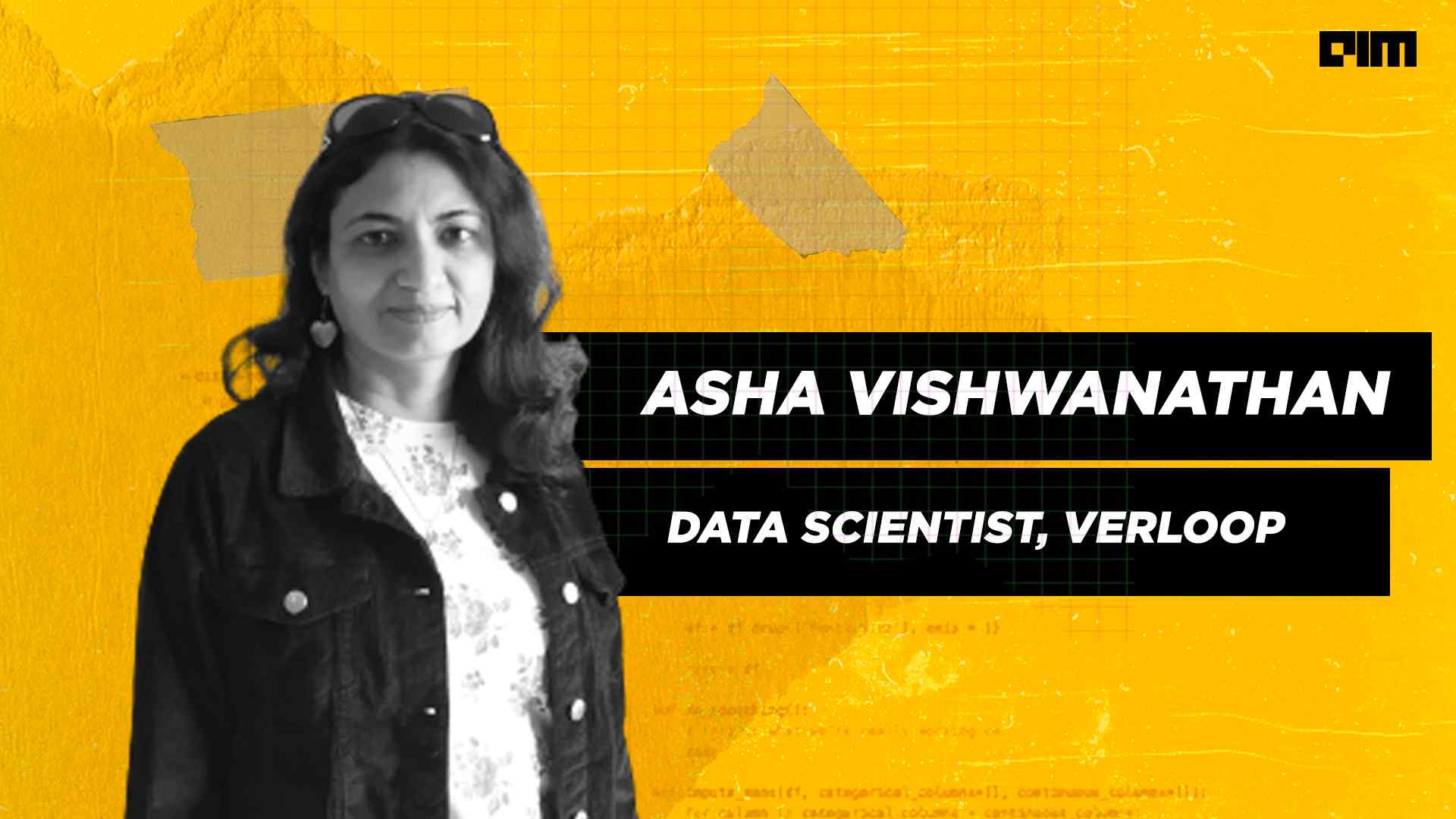
Asha Vishwanathan leads the machine learning division at Verloop.io, a Conversational AI platform. Her expertise lies in NLP and computer vision and her career spans 15+ years. She got bitten by the data science bug in 2014 and made a pivot from analytics. “ML piqued my interest as it was the perfect blend of programming and data related technologies that I had been dealing with in my career,” said Asha.
Register for our Free hands-on workshop
Analytics India Magazine spoke to Asha to understand her data science journey. “Disregarding your past experience and starting afresh is a challenge that one must overcome while transitioning between different job profiles,” she added.
AIM: In spite of a successful career in analytics, what made you switch to the world of data science?
Asha Vishwanathan: After working for almost a decade with major IT brands, from corporates to budding startups, I took a sabbatical from work to explore my ‘Ikigai’ and went back to basics to understand what actually made sense to me. Upon realising I have an affinity towards programming, I moved to machine learning. Things got interesting when I took a course on data science through Coursera and my interest in the field developed.
AIM: How did you develop your data science skillset?
Asha Vishwanathan: I started with a lot of general reading on the basics. I started with research on business intelligence as it was something that I had worked on before. Having a background in business intelligence, data visualisation, reporting and dashboarding, I understood the nuances and found data science in this field to be a natural extension of what I had been doing. My own past experiences and understanding of the field guided me through the vast universe of data science. I started off by doing an introductory course through Coursera to gain a basic understanding of the field and later found a lot of online material. However, the online resources lacked a structured approach and one can easily get lost in the world of data science. Doing advanced courses on R and Big Data through Jigsaw gave me clarity on the path I wanted to take. In 2020, I did a business analytics course at the Indian Institute of Management, Bangalore which gave me a sweeping understanding of the data science scene.
AIM: How did you feel when Harvard Business Publishing chose your case study on skilling needs of the Indian ecosystem?
Asha Vishwanathan: The project was actually about identifying the skilling needs in the Indian ecosystem. The government provides a lot of schemes and initiatives to train and enable the common people. But, many drop out or are unable to complete such courses. We wanted to find out the root cause of this discontinuation and our research revealed that the skillset provided by the courses did not match the required job profiles. So we decided to look at building a system that would recommend the type of skills that the target audience needs for specific job profiles. It was a challenging process as many candidates were from a blue-collar segment and lacked a basic resume. Taking into account people from different backgrounds like coconut vendors, labourers, plumbers, etc., we created a model to predict the possibility of such individuals passing the aforementioned certifications using previous assessment data. We took data from soft skills required from the job, skills that the individuals have married them all in a comprehensive recommendation model that caught the eye of Harvard business publications.
AIM: When did your data science journey actually begin?
Asha Vishwanathan: I was already working in data science before joining IIMB. But I decided to do more to understand the breadth of the field. I soon realised that I have stumbled into a niche of machine learning while working in Kernel Insights. The road took many turns after I got certifications from Jigsaw and I joined a company called Poolcircle. There, I worked on changing the ride-sharing scene in Bengaluru using ML methodologies and data science. To change the way people commute, we looked into making a product that recommended routing strategies. After Poolcircle, I joined an early-stage startup called Kernal Insights where I tackled computer vision problems.
AIM: What kind of projects are you heading in Verloop.io?
Asha Vishwanathan: After joining Verloop.io, I tackled projects around NLP and conversational AI as I realised there are a lot of similarities between how the models work across computer vision. I faced challenges specific to chatbots, the whole ecosystem that it caters to and their implementation in typical B2B, SaaS type models. Working on the hosting and deployment of such models is especially interesting as it is not just restricted to machine learning algorithms but also about scaling up the project to meet industry standards. Looking for a solution from an end-to-end standpoint is what excites me the most.
AIM: What’s your advice for data aspirants?
Asha Vishwanathan: Data science is a detail-oriented and rigorous field. In order to make it in this market, you must get down to the basic principles and understand if it is their cup of tea. You should also be able to persevere through algorithms day after day and work on similar problems without being saturated. Don’t just blindly dive into it because it’s trending, you might not like it later.
Conference, in-person (Bangalore)
Rising 2022 | Women in AI Conference
8th Apr
Webinar
Masterclass on AI innovation with oneAPI by Intel
13th Apr
Conference, Virtual
Data Engineering Summit 2022
30th Apr
Conference, in-person (Bangalore)
MachineCon 2022
24th Jun
Conference, in-person (Bangalore)
Cypher 2022
21-23rd Sep
Stay Connected with a larger ecosystem of data science and ML Professionals
Discover special offers, top stories, upcoming events, and more.
In digital image processing, a lot of various methods are used to increase the quality of the image such as noise reduction, high resolution, etc. Image illumination is one such technique that highly affects the quality of the photo.
Orchest is a tool that can be utilized for building machine learning pipelines. Using this library we can build pipelines in a visualized manner using the Orchest provided user interface. One of the best things about this tool is it doesn’t require any third-party integration or DAGs.
BART stands for Bayesian Additive Regression Trees. It is a Bayesian approach to nonparametric function estimation using regression trees.
As the name suggests Scikit-plot is a package that helps us in the visualization process. Since visualization plays a crucial role in the life of data science processes we always need some libraries that can help us in making meaningful visualizations.
With the recent advances of self-supervised learning, pre-training techniques play a vital role in learning visual and language representation.
Auto-generated suggestions are currently available to Google Workspace business customers.
EvalMl is a python library for automated machine learning that helps us in building, optimizing, and evaluating machine learning pipelines.
XAutoML is an analytics tool that explains the AutoML optimization procedures and machine learning pipelines constructed by AutoML.
In this article, we will look at how to use graph objects (module) of the Plotly library, explaining it from the ground up, and covering all of the most commonly used charts.
In many cases, the relationship between input and output could be too random or not sufficiently related.
Stay up to date with our latest news, receive exclusive deals, and more.
© Analytics India Magazine Pvt Ltd 2022
Terms of use
Privacy Policy
Copyright