

Getty Images
American stock markets were volatile again Monday as investors processed a laundry list of new developments in Russia's invasion of Ukraine.
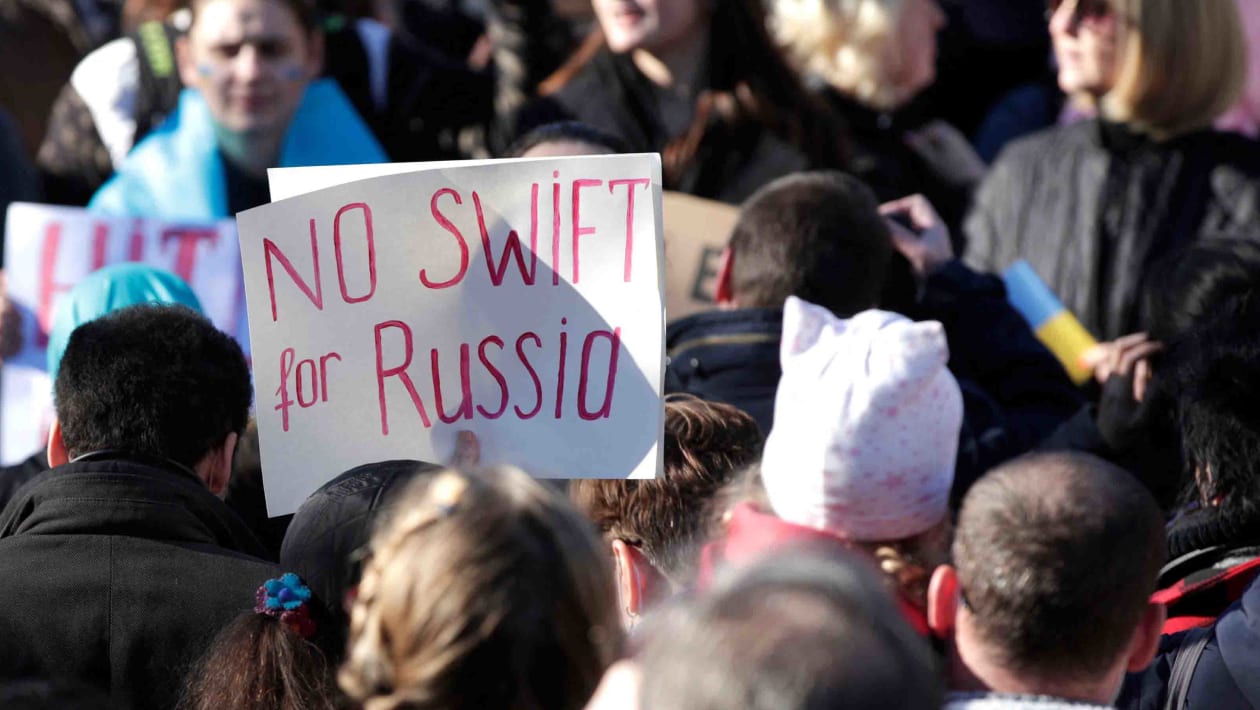
Among those events: The U.S. and European nations have largely coalesced around the Ukrainian cause, providing varying military aid as well as isolating Russia through numerous new sanctions, including banning some Russian banks from using the SWIFT system that enables financial firms to settle cross-border transactions.
Also, as we mentioned in our free A Step Ahead e-letter, these efforts extended to the public markets. On Sunday, BP (BP, -5.0%) said it would exit a nearly 20% stake in Russian oil giant Rosneft, and on Monday, Shell (SHEL, -3.4%) announced it would exit all Russian operations, including a liquefied natural gas plant part-owned by Russia's Gazprom.
Regardless, it was still a great day for energy, which was the strongest S&P 500 market sector at 2.5%. U.S. crude oil futures rocketed 4.5% higher, to $95.72 per barrel, while Brent (global) crude topped $100 per barrel – lifting U.S. exploration and production companies such as Occidental Petroleum (OXY, +12.9%) and EOG Resources (EOG, +7.1%).
Meanwhile, the New York Stock Exchange and Nasdaq temporarily halted trading in several Russian stocks, and broad baskets of Russian equities – including the VanEck Russia ETF (RSX, -30.5%) and iShares MSCI Russia ETF (ERUS, -27.9%) – plunged.
The major indexes fininshed Monday in mixed fashion. The Dow Jones Industrial Average was off 0.5% to 33,892.60, closing down 3.5% across February. The S&P 500 lost a modest 0.2% to 4,373.94, declining 3.1% for the month. And the Nasdaq Composite managed to end the session up 0.4% to 13,751.40, checking out of February with a 3.4% drop.
Sign up for Kiplinger's FREE Investing Weekly e-letter for stock, ETF and mutual fund recommendations, and other investing advice.
One thing to watch going forward, say Jason Pride and Michael Reynolds, CIO of private wealth and vice president of investment strategy, respectively, at investment firm Glenmede, are additional supply-chain disruptions.
"The European Union relies on Russia for more than a third of its natural gas supply. Also, Russia and Ukraine combined account for a quarter of global wheat exports," they say. "Additionally, Ukraine is the source of 90% of the world's semiconductor-grade neon and Russia is responsible for 24% of palladium exports. Such large presence in these markets could cause more disruptions to already strained supply chains."
YCharts
Other news in the stock market today:
Every quarter, we take a long gander at what Wall Street's "smart money" is up to.
Naturally, Warren Buffett tends to dominate the spotlight – his Berkshire Hathaway equity portfolio is regularly scrutinized by those wondering what the world's most famous investor is buying and selling from one quarter to the next.
But we also look at which stocks have garnered the most attention from the hedge fund community.
Yes, hedge funds as a whole actually have a pretty poor long-term track record, but given their collective resources, monitoring their most popular ideas can still be educational. And let's give theim their due: Hedge funds are having a market-beating 2022 – which one would expect, as their hedging strategies are designed to limit downside risk. Unsurprisingly, hedge fund managers are elbow-deep in blue-chip stocks, as their massive market capitalizations and liquidity allow institutional investors to buy and sell in large quantities without drastically affecting pricing in those stocks.
Here, we look at the 25 blue chips that these smart-money managers are stashing away.
Kiplinger is part of Future plc, an international media group and leading digital publisher. Visit our corporate site www.futurenet.com
© Future US LLC, 10th floor, 1100 13th Street NW, Washington, DC 20005. All rights reserved.